

How to Plan a Week You'll Actually Stick To (Sort Of)
Photo by DS stories
TL/DR:
The point of planning isn't to follow your plan exactly. It's to decide what you're not doing and to feel confident in your time tradeoffs.
"Structured fluidity" is planning for the time you have, then giving yourself permission to move things around as energy, motivation, and reality shift.
Plan ruthlessly realistically (maybe even pessimistically) so you rightsize what fits in a week.
Buffer is the secret ingredient. Without it, one surprise creates a cascade of stress and late nights.
The Whole Shebang:
There’s a thing I do with my calendar that my husband assures me is nuts (but I do it anyway, because I find it helpful.)
What is it?
Adjusting the time-blocking on my calendar after the fact, so that it reflects the reality of what actually happened.
It doesn’t take long (seconds!); I do it as I’m moving things around, as meetings come on and off the calendar, and as things (inevitably) take longer than expected.
And, well, today you’re getting a real window into my actual workweek from last week (as I write this, and 2 weeks ago, as you read this); both what I planned, and what I actually did.
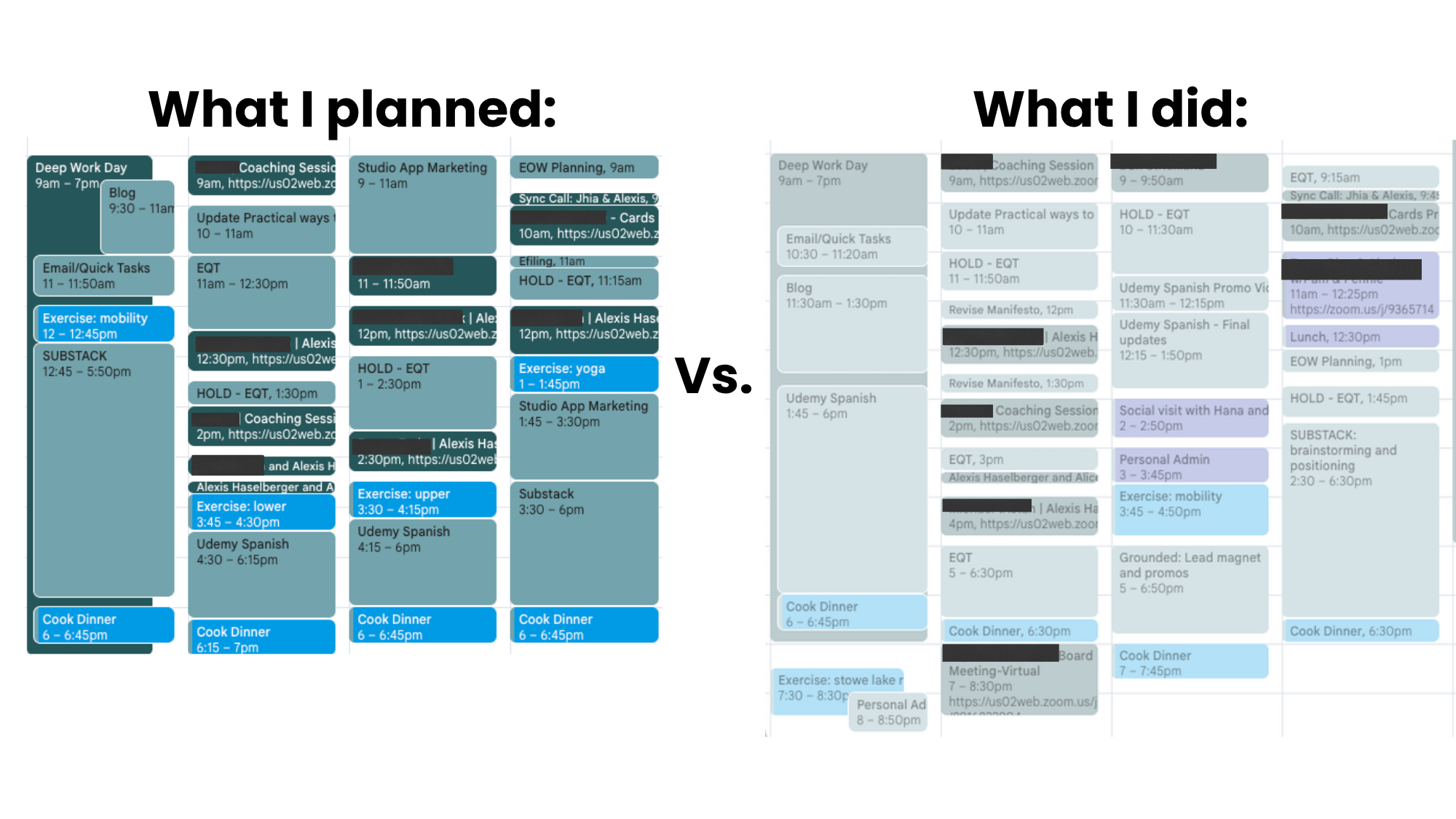
If you look at that “before and after” picture of my week above, you might think I’d “failed” at my plan. (And, if you’re not seeing the image in your inbox, click through to see it on my website.)
After all, the reality looks quite different from the plan.
But I don’t think of it as failure.
Because I don’t think the point of planning is to follow the plan exactly.
And, in fact, if you follow a plan exactly, without accounting for new information that should, by all accounts, change the plan, well, that makes no sense at all.
We live in a world that changes and we don’t have control over all those changes. But we can plan for and around the fact that things will change.
The point of planning, IMHO, is 2-fold:
To decide what you’re NOT going to do (so that you can practice Task Realism)
And so that you can feel confident in your decisions, tradeoffs, and pivots with your time.
Look, if you existed in a vacuum, with no external forces pulling on you, maybe, just MAYBE, it would be reasonable to think that you could follow a plan exactly.
And that’s if you were also an expert time estimator who never gets distracted by anything, which, I’m sorry to say, isn’t most people.
Definitely not me.
And probably not you.
And you also might say, well, “what’s the point of planning at all, of you’re not going to follow it?”
To which, I’ll direct you back to the 2-fold purpose of planning:
To decide what you’re NOT going to do (so that you can practice Task Realism)
And so that you can feel confident in your decisions, tradeoffs, and pivots with your time.
So, if I don’t think of “not following the plan exactly” as “failing”, then what is it?
Well, I like to think of it as the practice of something I’ve coined “structured fluidity”.
On a weekly basis, I do my best to plan for the time I actually have (not the time I wish I had).
And I also make room for the idea that I might not want to do the things I’d planned exactly when I’d planned them.
The time blocking helps me visually see how much time I think things will take (realistically! Maybe even pessimistically! But definitely not optimistically because that’s a recipe for disaster).
Ruthlessly realistic planning helps you rightsize the “amount” of things you need to do in a week.
And when you practice “structured fluidity” you give yourself the permission and freedom to move things around without feeling like you’ve failed.
Because:
Sometimes, your energy is misaligned with what you’ve assigned yourself.
In the example above, you can see I started Monday later than I’d planned, because I was tired, and I’ve built in buffer to allow for that.
Sometimes, you’re feeling excited about something else you’ve planned for later this week, and you just want to do it NOW, to ride that motivation while you’ve got it.
In the example above:
I was feeling motivated to get a new course finalized so I shifted that work to Monday AND
I got invited to speak at a summit, and there was some work I needed to do on rather short notice that came out of a meeting I had ton Tuesday.
Sometimes things take longer than you think. (And rarely, but yes, sometimes, less time than you think.)
In the example above, I underestimated how long it would take to get that new online course finalized and published.
Sometimes (er, often), a surprise meeting gets added to your calendar or someone reschedules.
In the example above, my Wednesday and Thursday had a fair amount of meeting movement, with some added and some removed.
In the end, I achieved my goals for last week, but not exactly in the way I’d planned, and that’s OK. (In fact, I think it’s great!)
But, I’d be remiss if I didn’t mention that there’s one key factor why this works, and that’s the concept of buffer.
When I plan, I make sure that I schedule the work with ample time before any deadlines I’ve committed it. This gives me much, much more freedom to use the concept of “structured fluidity” and to work around changes to my schedule, my energy, or the actual content of my task list as new things arise.
If you’re time-blocked to within an inch of your life, you don’t have any leeway when things (inevitably) change.
But, when you plan with buffer, good things happen:
You’ll be a lot less stressed because if things take longer than you expect you won’t be scrambling.
You’ll have far fewer days where you need to work late due to new and unexpected work; your day will be able to absorb it. Because you’ve planned for it. Even if you didn’t know what “it” was.
You’ll have far fewer work “emergencies” that encroach onto your personal life because you will have built in the time to handle them. When your schedule is packed super tight, there’s virtually no room for error. One little extra thing can cause a negative cascade of events. An urgent request comes in, you do it, but then you don’t have time for the other things you planned to do, so you have to move some of those to later in the week. But the rest of your week is also packed so tightly that there’s no room for these things, so you feel like shifting ALL your future plans or pulling an all-nighter are the only options.
Are you ready to shift the purpose of planning?
And stop beating yourself up for not following your plans perfectly?
If you’d like some help, here are 4 ways we can work together:
Download the Do More, Stress Less App
Daily personalized coaching that adapts to your brain, your goals, and your life. Like having a productivity coach in your pocket.
Get started here.Enroll in the Time Well Spent course
Bite-sized, shame-free steps to take control of your time, and your life. Built for real people with big lives, big jobs, or both.
Learn more, or enroll here.Get 1:1 Coaching
High-touch coaching for people managers, leaders, executives and founders who need a trusted partner to streamline priorities, manage the overwhelm, and focus on what moves the needle most.
Schedule a call to explore if this is the right fit for you.Explore Team Workshops/Training
Customized workshops and trainings to help your team improve productivity without burnout and create a culture where people (actually) thrive.
Schedule a call to explore if this is the right fit for you.
